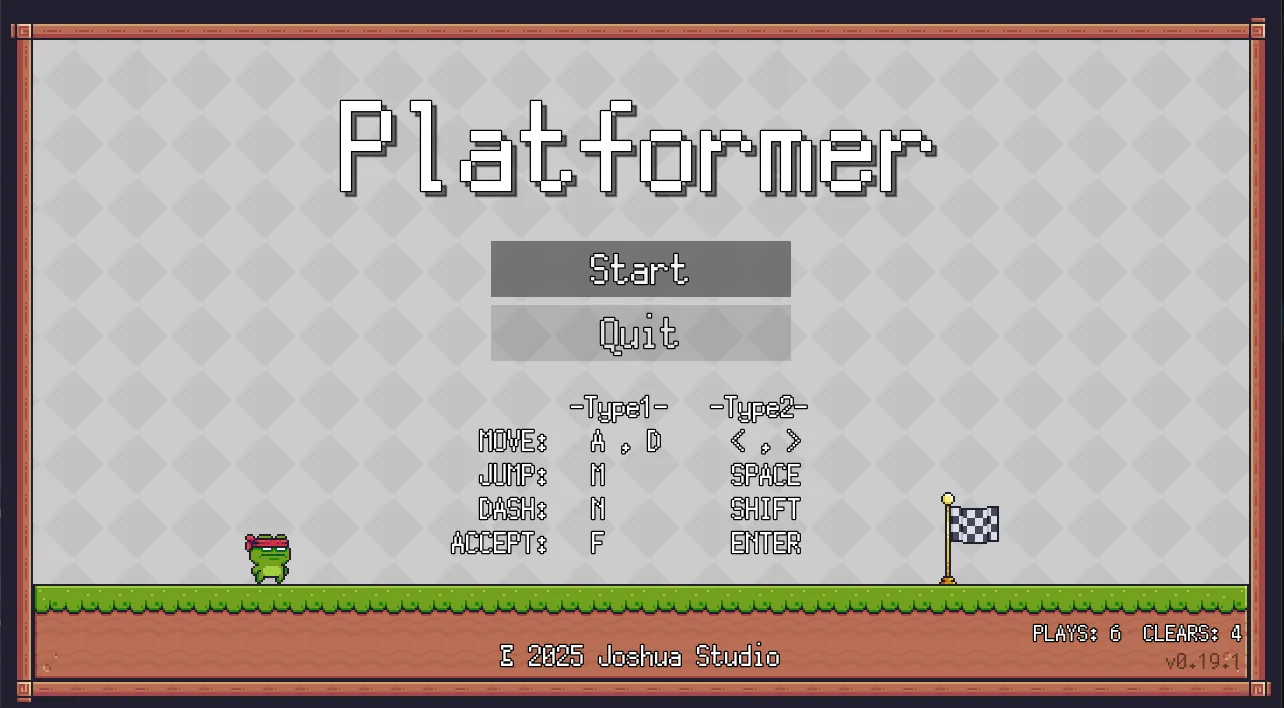
Godot 2D Platformer is a study in tight, expressive movement. It layers dash mechanics, high jumps and double jumps into a control scheme that feels closer to a polished Mario game than a tutorial project.
The Challenge
Platformers live or die on the feel of movement. Getting dashes, high jumps and double jumps to coexist without feeling floaty or unfair means tuning acceleration, gravity and input timing until the character responds exactly the way the player expects.
The Approach
I built each movement ability as a focused, testable piece of behavior and tuned them together by feel, iterating on jump arcs and dash distances until traversal became satisfying on its own. The level design then exists to show off that movement rather than to hide weak controls behind difficulty.
Tech Choices
Godot and GDScript provide a fast iteration loop for 2D physics and input handling, which is essential when you are tuning movement frame by frame. A web export makes the result instantly playable in the browser, lowering the barrier for anyone who wants to try it.
What I Learned
This project reinforced that game feel is engineering, not luck — every satisfying jump is a stack of small, deliberate numbers. Exporting to the web also taught me how to keep a real-time game responsive inside a browser sandbox.